Showing posts with label Jewish learning. Show all posts

Tuesday, January 25, 2011

Remarketing Jew Education

This week the Jewish Educators Associatian (JEA) is having their annual conference. This coming week, I will be joining my colleagues from the National Association of Temple Educators (NATE) at our  annual conference in Seattle. Both the Conservative JEA and the Reform NATE conferences are making technology and futuring the centerpiece of their learning. It is very exciting. 


In The Networked Non-Profit, Beth Kantor and Allison Fine point out that when it comes to Social Media, the important word is SOCIAL not MEDIA. In other words the technology is a tool for bringing people together, and in our case, making Jewish learning happen.


Joel Grishaver has posted what I think is a very interesting idea about futuring on his blog, The Gris Mill, and I am glad he wrote it now so I can think about it while I am learning in Seattle. - Ira Wise


Remarketing Jew Education
by Joel Lurie Grishaver


We are at an interesting moment in the world of parenting. This parenting chaos directly impacts the way we present ourselves as Jewish “schools.”

The first voice is Amy Chua, author of  "Battle Hymn of the Tiger Mother,"  who says give your child no room to do anything but succeed. The other voice is Wendy Mogul, whose long overdue second book, “The Blessings of a B-Minus,” cajoles us to accept our child as human beings. Both books are now coming to prominence. One is about high achievement, the other is about resilience. Both take a swipe at the long over emphasized issue of self-esteem.

Chua wants us to be tougher on our kids and demand “perfection.” Mogul understands that “failure” is a useful growth opportunity. Both of them wind up as commentary on new reports about the failure of American schools to even teach the difference between facts and opinions and the overall failure of American Universities to make any impact on the learning of many of their present students. Richard Arum, lead author of the study, “Adrift: Limited Learning on College Campuses” (University of Chicago Press) came out in January, too, is the third voice putting the foundations of the way we parent at risk.

Believe it or not, all this comes back to the role and optics of Jewish schools, particularly Jewish supplemental schools. Who we are as a school has a lot to do with what our parents believe a school is.

We are simultaneously being told be like regular schools and become technological. At the same time we are being told, don’t be like a school at all (we’ve had enough of that) be a camp or a program or something interesting (and do that using a lot less time). What is common knowledge every where but in our classroom, is the universal belief that the present Jewish schooling system is a total failure.
Here is a radical idea. We ought to play to our own strengths. We know that the Jewish tradition centers on learning how to close-read texts. (Think reading comprehension!) That we use a thing called “Talmudic Logic” that teaches you how to evaluate evidence, reason, and know the difference between fact and opinion.

Jewish schools can and should do camp pretty well. We need to get better at technology. For sure, our tradition centers on building both self-esteem and resilience. But, what Judaism really is good at is learning—deep learning.

In the future, when the alternative (for example) is 10 minutes of Skype a week plus one informal event a month probably involving families, we will brag:  “We help our students become better learners.”
Camp will do camp better than we do. Other schools will always have more money to spend on technology than we do (and Web 2.0 apps only go so far). But what we can really brag about is “let us teach your children the Jewish tradition and they will do better in life.”

We will incorporate the camp selling point: “You children will make friends to last a lifetime.” We will have the technological appeal: “We allow your children to remix the Jewish tradition.” But our unique promise is about learning skills. Right now we teach not language but mechanical reading. Language provides useful insight. Mechanical reading is self-serving. We are geared to teach names and facts, but “meaning” and “insight” are what are precious. We have to work to make our classrooms both challenging and responsive, and those are goals we can achieve. It is perhaps the only truth that will keep us in business.

To stay on the weekly schedule, to make it worth the carpool time, Jewish Schooling has to have advantages. The good thing is that we own them: Friends, Remixing, Creativity, Resilience, and Academic Excellence. We know how to do this—we simply need to become good Torah teachers and not a pale imitation of secular schools.

Cross posted to The Gris Mill and Welcome to the Next Level

Sunday, December 26, 2010

"Super..." and "Amazing..." Curricular Projects

This is cross-posted from Caren Levine's blog  jlearn2.0. Caren is one of those people who is always thinking about the intersection of Jewish education and technology. Her digital and analog lenses work in stereo, kind of a unified field theory of Jewish education. She cross-posted it to YU 2.0, a wonderful membership site maintained by our friend and fellow JJF Fellow, Dr. Eliezer Jones.

A question I am often asked is, "Yes, but what are some examples of how these resources are integrated into the curriculum? By real live educators with real live learners!"

Presenting two free ebooks to whet your appetites and tickle your imaginations:

The Super Book of Web Tools for Educators: A comprehensive guide to technology in all k-12 classrooms. Articles include perspectives from administrators and teachers, as well as elementary school, middle school, and high school projects, and projects centered around particular subject matter or tools (ESL, Skype, blogging). Contributors include notable education bloggers Steve Anderson, Richard Byrne, George Couros, Larry Ferlazzo, Silvia Rosenthal Tolisano, and others. Check it out!


But wait, there's more! Be sure to read through Terry Freedman's The Amazing Web 2.0 Projects Book, a compilation that is chock full of practical ideas for the classroom. The many contributors include an international cast of educators such as Terry Freedman, Jackie Gerstein, Julie Lindsay, Sharon Peters, Shelley Terrell, Silvia Tolisana, Jen Wagner, and Reuven Werber, to name drop just a few.


Tuesday, May 11, 2010

Two Types of Freedom

Imagine sleeping late for the most important appointment of your life! According to Jewish tradition, that is exactly what the Jewish people did the morning they were to receive the Torah at Mount Sinai. To make certain that this doesn’t happen again, many Jewish communities stay up for an all-night study session the first evening of Shavuot (Erev Shavuot). This special tradition, called a Tikkun Leil Shavuot, hopes to ensure that the Jewish people make it to their Mount Sinai meeting on time.

Shavuot, also called the Festival of Weeks, is the second of the three Festivals of the Jewish year. Like many Jewish holidays, Shavuot has both agricultural and religious significance. Shavuot celebrates the harvest and dedication of the first fruits of the agricultural year and the giving of the Torah at Mount Sinai. For this reason, Shavuot is also often called both Hag HaBikkurim (Holiday of the First Fruits) and Hag Matan Torah (Holiday of the Giving of the Torah).

However, the connection between Passover and Shavuot is perhaps the most important aspect of this holiday’s celebration. Passover celebrates the escape of the Israelites from slavery in Egypt. But what happened after that miraculous escape at the Sea of Reeds? Seven weeks later, the Israelites stood at Mount Sinai and were given the Torah. As Passover celebrates physical freedom, Shavuot celebrates spiritual freedom through the covenant made between G-d and the Jewish people millennia ago.

Unfortunately, Shavuot often falls during the summer and many people forget about this celebration altogether (There is no excuse this year, as Shavuot is at the end of May). Additionally, Shavuot may be less “memorable” because it doesn’t have a unique experience as part of its celebration. Sukkot has the sukkah, Passover has the Seder, Purim has the costumes, and Shavuot is primarily a synagogue based holiday exactly at the time when synagogue attendance starts to wane in the summer season.

Nevertheless, participating in a Tikkun Leil Shavuot is a great way to throw you into Jewish learning and provides a great opportunity to become re-inspired to explore Judaism anew. I have participated in all-night study programs that explore everything from classical biblical texts to the growth of the Israeli wine industry. With a diversity of learning experiences, everyone has the opportunity to stay engaged and awake. Plus, all-night learners really feel a sense of accomplishment if they make it to dawn on Shavuot morning.

Study is central to the Jewish people. Jewish study is not about mastering knowledge; rather it is about using what is learned to affect how we live. We study the Torah all year, every year because the work that we put into study has the potential to transform our lives. This is why Ethics of the Fathers reminds us that the process of Torah study is to “turn to it, and turn to it again, for everything is in it. Pore over it, grow old and gray over it. Do not budge from it. You can have no better guide for living than it” (Avot 5:25). Take some time this year to study our tradition.

Shavuot begins the evening of Tuesday, May 18, 2010, the 6 Sivan 5770. For more information about Shavuot, check out www.myjewishlearning.com.

Monday, April 5, 2010

Put Your Own Oxygen Mask On First,
And Then Help Your Children

Taking A Year Off
This past fall many Jewish educators encountered a newish phenomenon. Some families in our religious schools were “taking a year off” from Religious School and in some cases synagogue membership. If these were families whose youngest child recently became Bar or Bat Mitzvah, we might wring our hands and say “Ri-i-i-ight. Taking the year off. We’ll look for you next fall.”

But most of these families in my synagogue and in those of colleagues who have told me they have encountered the same conversations have children who are much younger. They tend to be in Gan (K) through Kitah Gimel (3rd). In fact, our enrollment from Kitah Chet (8th) through Kitah Yud Bet (12th) is at an all time high. If pushed, some parents will say it is a temporary economic decision. They indicated the economic realities of the fall of 2010 and a belief that their child’s Jewish identity will not be irreparably damaged by a break in their studies. And they absolutely did not want to discuss financial aid – either they were too uncomfortable with the topic or they didn’t feel things were that bad. They promised to come back. And in some of the conversations I am beginning to have with these hiatus families, they are telling me that they are absolutely coming back. From their mouths…

Linchpin: Are You Indispensible?

I am nearly finished with a book call Linchpin by Seth Godin.[1] I am a Godin Junkie. I first met Seth’s work in the pages of Fast Company, another of my addictions. Both are from the world of business, not Jewish education. Both have taught me so many things about how to make Jewish education happen. I cannot recommend them enough. I could write ten articles about this book, beginning with how it was marketed. I am reading it with a small moleskine notebook next to me so I can take notes. Yes, it is that engaging.

At the heart of the book is a redefining of the American Dream: “Be remarkable. Be generous. Create Art. Make Judgment Calls. Connect people and ideas. And we will have no choice but to reward you.” He challenges the reader, regardless of your field, to be an artist, which he defines as “someone who changes everything, who makes dreams come true…someone who can see the reality of today and describe a better tomorrow…a linchpin.”

A linchpin. The pshat or plain meaning is the piece of metal that slides through the axle that keeps the wheel from falling off the wagon, or through the arm and the hitch to keep the trailer attached. It is a simple device yet it keeps things together and makes their proper function possible. Godin suggests that in our work, each of us needs to be a linchpin, someone who is indispensable to their company. Not a line worker or a rule follower, but an artist – someone who stretches possibilities to allow growth and change. He gives great examples.

Al Tifrosh Min Hatzibur - Do Not Separate Yourself From the Community
So why am I bringing this up while talking about the interrupted life of our students? I believe we need to do a better job of making the school and the synagogue (and the Jewish educator) linchpins in the lives of our families. I think that twenty years ago, no one would have considered “taking a year off.” That generation might have considered the financial ramifications when joining a synagogue. Once in, though, I am convinced that like their predecessors, they would not consider leaving – at least not before the youngest child’s Bar/Bat Mitzvah. I think that we have witnessed evidence of a paradigm shift in the mind of some of our parents. And because the synagogue is no longer a linchpin for some, they are making choices we have not seen before.

Much has been written about what needs to happen to make the synagogue and formal Jewish education more relevant. And some of it may be right on target. But before we go exploding all of our existing institutions, I have a thought. We need to be linchpins. By “we” I mean the synagogue, the school, the clergy, the directors of education/lifelong learning/early childhood/family education/programming/fill-in-the-blank, the teachers and the lay leadership.

In 1989 United Airlines ran a television commercial showing a conference room. “A manager announces they have just lost a major long-time client, one too many. It's time for a "face-to-face" policy, in other words, not just call the customer, but also meet him. He starts handing out plane tickets to the other employees...” [2]


They had the idea exactly right. We need to focus our energy on each adult, one family at a time. It’s not an easy task, given the size of some of our congregations. It is not a one-person job. I intend to become an evangelist, recruiting those who already feel that being a part of a congregation – learning, praying and coming together for ma’asim tovim (good works) and for fun – is not something to be weighed against other household expenses and youth activities. We need to get them join us in reaching out, one family at a time, and helping those families come to the same conclusion. We have to lose the model whereby the educator focuses on the children and that leads to families becoming more connected.

Put Your Own Mask On First…
Finally, I want to share the teaching of Harlene Winnick Appelman, the director of the Covenant Foundation. Harlene was one of the first winners of the Covenant Award, and was one of the first people to take the idea of family education and develop it into something more comprehensive than a special program on a Sunday morning. Her sessions at CAJE conferences were a must-attend for those who wanted to be on the cutting edge.

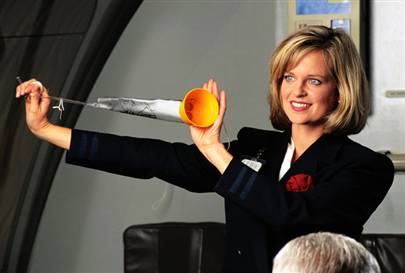
She reminded us of the safety speech that flight attendants used to give before takeoff (now it is usually on a video). They would say that in case of a sudden loss of cabin pressure, oxygen masks would drop from the ceiling. After instructing us how to put it on and start the flow of oxygen, they would tell us that passengers traveling with young children should put their own mask on first and then help their children. Harlene taught us what should have been (and should still be) obvious: If you put the child’s mask on first, we might not be able to breathe well enough to take care of ourselves. And what if our children need us after getting the mask on?

We need to get the parents to put on their Jewish learning and living masks. Otherwise we will have a generation of adults with the Jewish identity and connection of at best a thirteen year old. We need to get them to understand that they need to belong to a synagogue and send their children to religious school (or day school) because that is something that is vitally important to them. And we can only do that through personal relationships. We need to be artists.

I have some ideas. More on this soon.

Cross-posted to Welcome to the Next Level


[1]Seth’s blog is at http://sethgodin.typepad.com/seths_blog/ and his books can be found at http://www.sethgodin.com/sg/books.asp. I have taught about The Idea Virus and the Purple Cow, and recommend them!

[2] Thanks to http://www.airodyssey.net/tvc/tvc-united.html" for the description of the ad and the link to the Leo Burnett Ad Agency site for the clip.

ShareThis