Showing posts with label synagogue. Show all posts

Thursday, November 3, 2011

Connecting the Affiliated

My friend and colleague Arnie Samlan posted about a conversation he had with Beth Finger, who is working on a project called Jewish Without Walls. They suggest we "Forget about Jewish Affiliation, Think about Jewish Connectedness:"
"During our conversation this morning, we both challenged the relevance of "Jewish affiliation", which has been used in every Jewish demographic study as a measure of community success in modern America. The problem is, and has always been, that the operational definition of "affiliation" is often "pays dues to a synagogue". Even those who expand the definition someone, rarely get beyond handing money to an organization (JCC, Federation, Hillel) as the operational definition."
He explores several problems with using affiliation as a metric, including leaving our serious Jews who are "not religious," those for whom membership is of little if any value, and that it does not include significant numbers of Jews who relate to their Jewishness independently, including growing numbers who use social media to express their Jewishness.

He (with a nod to Beth Finger) suggests changing the metric to  "Jewish Connectedness." He would like Jewish sociologists to take into account the many ways of relating meaningfully to being Jewish. He wants to find a way to include serious Jewish paths that may not lead through a synagogue, federation or JCC. He includes summer camping and independent minyanim as well as those "who are doing Jewish in non-institutional spaces or in secular spaces, Jews connecting online in meaningful ways folks and who participate in Beth's Jewish Without Walls, in havurot and in other groupings that are not (yet) dues-based groups."

I think Arnie has the beginnings of an interesting framing of the conversation that we have all been having for a while. And while those who would overturn existing institutional frameworks might see this as invitation Occupy Organized Judaism, I see it as a refreshing way to begin talk about the apples and oranges in the same conversation. After all, Apple Jews and Orange Jews are still all Jews!

I would press the idea a bit further:

How can we in the synagogue world change the way we operate to increase the CI - Connectedness Index - for each member family and individual? While we in this world often do a lot to attract affiliation, we don't always (or even often) do a good enough job of connecting them to other adults in our congregations. We get them when they feel they need us (religious school, nursery school, Bar/Bat Mitzvah) but we don't always connect the adults in the family. So when the kids are ready to move on, the adults do as well.

Using the CI as a way to measure and improve what we do is as important as using it to find a meaningful category for non-Congregational connecting. I still like the word "affiliate" though. It makes me feel like we can use it to affirm that we obeying Hillel's dictum not to separate ourselves from the community.

Like Arnie, I am not the statistician to figure out how to count these things in the larger picture. I do know that in our synagogue and religious school, we have begun to focus on connecting parents. Our room parents now focus on getting parents together rather than doing the shopping or helping with the seder. (See article on page 6 Torah at the Center). I challenge you to share more ways of connecting the people who ARE affiliated! Because we need to raise the CI of all of our people!

Cross posted to Welcome to the Next Level

Monday, September 20, 2010

Dropping the Baton in the Synagogue

This is from the July issue of FastCompany. FastCompany is a business magazine, and ever since the first issue came my way fifteen years ago I have read it cover to cover. Each month I find articles that make me think about my work as a Jewish educator and as a human being. There are more ideas than I have had a chance to implement and the list grows longer each month. It has introduced me to Seth Godin, the importance of Design and more recently Chip and Dan Heath.


This article made me think about the process of recruiting, and more importantly growing and maintaining the relationships with a member family in our congregation. They come in through so many different doors: nursery school, family education, social justice, a desire to enroll children in religious school, a worship experience, spiritual searching - you name it. And then we get them to join. 


Some time later - hopefully years - they resign. And we are shocked, I tell you. Simply shocked. (cue Sam on the piano - you must remember this...)


Why would they leave? Perhaps they have accomplished what they thought of as their purpose for joining. Maybe the kids have left the house so they see no reason to belong for themselves. Maybe the dues are too high. Maybe, maybe maybe.


This article made me wonder how many ways we drop the baton in our synagogues. With our students. With their parents. With the family as a whole. We should have been working to help them find multiple reasons for being connected to the temple, to develop relationships with other members and with the institution itself that go beyond the reason they joined. I began this line of thought on this blog in April. I am sure there is more to come. I invite your thoughts on this.

Team Coordination Is Key in Businesses

By: Dan Heath and Chip Heath July 1, 2010
At the 2008 Beijing Olympics, the American men's 4x100 relay team was a strong medal contender. During the four previous Games, the American men had medaled every time. The qualifying heats in 2008 -- the first step on the road to gold -- should have been a cakewalk.

On the third leg of the race, the U.S.A.'s Darvis Patton was running neck and neck with a runner from Trinidad and Tobago. Patton rounded the final turn, approaching anchorman Tyson Gay, who was picking up speed to match Patton. Patton extended the baton, Gay reached back, and the baton hit his palm.

Then, somehow, it fell. The team was disqualified. It was a humiliating early defeat. Stranger still, about a half-hour later, the U.S.A. women's team was disqualified too -- for a baton drop at the same point in the race. (Freaked out by the trend, the U.S.A.'s rhythmic gymnasts kept an extra-tight grip on their ribbons.)
Team U.S.A.'s track coach, Bubba Thornton, told the media his runners had practiced baton passes "a million times." But not with their Olympic teammates. Some reporters noted that Patton and Gay's practice together had been minimal.

Thornton's apparent overconfidence was understandable. If you have four world-class experienced runners on your team, shouldn't that be enough? Unfortunately, no, it isn't. The baton pass cannot be taken for granted -- not on the track and not in your organization.

We tend to underestimate the amount of effort needed to coordinate with other people. In one academic experiment, a team of students was asked to build a giant Lego man as quickly as possible. To save time, the team members split up their work. One person would craft an arm, another would build the torso, and so forth. (At least one person, of course, was charged with tweeting compulsively about what the others were doing.)

Often, the parts were carefully designed, yet they didn't quite fit together properly, like a Lego Heidi Montag. The problem was that nobody was paying attention to the integration. The researchers found that the teams were consistently better at specializing than they were at coordinating.

Organizations make this mistake constantly: We prize individual brilliance over the ability to work together as a team. And unfortunately, that can lead to dropped batons, as JetBlue infamously discovered back in February 2007.

You remember the fiasco. Snowstorms had paralyzed New York airports, and rather than cancel flights en masse, JetBlue loaded up its planes, hoping for a break in the weather. The break never came, and some passengers were trapped on planes for hours. If you've ever felt the temperature rise on a plane after an hour's delay on the tarmac, imagine what it was like after 10 hours. These planes were cauldrons of rage -- one stray act of flatulence away from bloodshed.

JetBlue did its best to survive the wave of hatred -- its CEO apologized repeatedly and the company issued a Customer Bill of Rights, offering cash payments for delays and cancellations. But the executives realized that these efforts wouldn't eliminate the underlying problems, which were rather unyielding: The weather is unpredictable; New York airports are overcrowded; passengers expect on-time performance anyway. If JetBlue didn't fix its operations -- learning to respond to emergencies with more speed and agility -- another fiasco was likely.

JetBlue's executives knew that a top-down solution by a team of executives would fail. "The challenges are on the front line," says Bonny Simi, JetBlue's director of customer experience and analysis. In October 2008, Simi and her colleagues gathered a cross-section of players -- crew schedulers, system operators, dispatchers, reservation agents, and others -- to determine how the company handled "irregular operations," such as severe weather.

Individual members of the group knew the issues in their departments, and "if we brought enough of them together," Simi says, "we would have the whole puzzle there, and they could help us solve it."
Where do you start? If you ask individuals what's wrong with their jobs, you'll get pet peeves, but those gripes may not address the big integration issues. But if you ask people directly how to fix a big problem like irregular operations, it's like asking people how to fix federal bureaucracy. The topic is too complex and maddeningly interrelated; it fuzzes the brain.

Rather than talk abstractly, Simi decided to simulate an emergency. As the centerpiece of the first irregular operations retreat, Simi announced to the group: "Tomorrow, there's going to be a thunderstorm at JFK such that we're going to have to cancel 40 flights." The group then had to map out their response to the crisis.

As they rehearsed what they would do, step by step, they began to spot problems in their current process. For instance, in severe-weather situations, protocol dictates that the manager on duty, the Captain Kirk of JetBlue operations, should distribute to the staff what's known as a "precancel list," which identifies the flights that have been targeted for cancellation. There were five different people who rotated through the Kirk role, and they each sent out the precancel list in a different format. This variability created a small but real risk. It was similar to slight differences among five runners' extension of the baton.

In total, the group identified more than 1,000 process flaws, small and large. Over the next few weeks, the group successively filtered and prioritized the list down to a core set of 85 problems to address. Most of them were small individually, but together, they dramatically increased the risk of a dropped baton. JetBlue's irregular-operations strike force spent nine months in intense and sometimes emotional sessions, working together to stamp out the problems.

The effort paid off. In the summer of 2009, JetBlue had its best-ever on-time summer. Year over year, JetBlue's refunds decreased by $9 million. Best of all, the efforts dramatically improved JetBlue's "recovery time" from major events such as storms. (JetBlue considers itself recovered from an irregular-operations event when 98.5% of scheduled flights are a go.) The group shaved recovery time by 40% -- from two-and-a-half days to one-and-a-half days.

Ironically, JetBlue's can-do culture contributed to its original problem. "The can-do spirit meant we would power through irregular operations and 'get 'er done,' " says Jenny Dervin, the airline's corporate communications director, "but we didn't value processes as being heroic." The company's heroes had been individuals -- but now they share the medal stand with processes. (Here's hoping that the next American relay team, too, extends some glory from the runner to the handoff.)

The relay team with the fastest sprinters doesn't always win, and the business with the most talented employees doesn't either. Coordination is the unsung hero of successful teams, and it's time to start singing.

Dan Heath and Chip Heath are the authors of the No. 1 New York Times best seller Switch: How to Change Things When Change Is Hard, as well as Made to Stick: Why Some Ideas Survive and Others Die.

Cross-posted to Welcome to the Next Level.

Monday, April 5, 2010

Put Your Own Oxygen Mask On First,
And Then Help Your Children

Taking A Year Off
This past fall many Jewish educators encountered a newish phenomenon. Some families in our religious schools were “taking a year off” from Religious School and in some cases synagogue membership. If these were families whose youngest child recently became Bar or Bat Mitzvah, we might wring our hands and say “Ri-i-i-ight. Taking the year off. We’ll look for you next fall.”

But most of these families in my synagogue and in those of colleagues who have told me they have encountered the same conversations have children who are much younger. They tend to be in Gan (K) through Kitah Gimel (3rd). In fact, our enrollment from Kitah Chet (8th) through Kitah Yud Bet (12th) is at an all time high. If pushed, some parents will say it is a temporary economic decision. They indicated the economic realities of the fall of 2010 and a belief that their child’s Jewish identity will not be irreparably damaged by a break in their studies. And they absolutely did not want to discuss financial aid – either they were too uncomfortable with the topic or they didn’t feel things were that bad. They promised to come back. And in some of the conversations I am beginning to have with these hiatus families, they are telling me that they are absolutely coming back. From their mouths…

Linchpin: Are You Indispensible?

I am nearly finished with a book call Linchpin by Seth Godin.[1] I am a Godin Junkie. I first met Seth’s work in the pages of Fast Company, another of my addictions. Both are from the world of business, not Jewish education. Both have taught me so many things about how to make Jewish education happen. I cannot recommend them enough. I could write ten articles about this book, beginning with how it was marketed. I am reading it with a small moleskine notebook next to me so I can take notes. Yes, it is that engaging.

At the heart of the book is a redefining of the American Dream: “Be remarkable. Be generous. Create Art. Make Judgment Calls. Connect people and ideas. And we will have no choice but to reward you.” He challenges the reader, regardless of your field, to be an artist, which he defines as “someone who changes everything, who makes dreams come true…someone who can see the reality of today and describe a better tomorrow…a linchpin.”

A linchpin. The pshat or plain meaning is the piece of metal that slides through the axle that keeps the wheel from falling off the wagon, or through the arm and the hitch to keep the trailer attached. It is a simple device yet it keeps things together and makes their proper function possible. Godin suggests that in our work, each of us needs to be a linchpin, someone who is indispensable to their company. Not a line worker or a rule follower, but an artist – someone who stretches possibilities to allow growth and change. He gives great examples.

Al Tifrosh Min Hatzibur - Do Not Separate Yourself From the Community
So why am I bringing this up while talking about the interrupted life of our students? I believe we need to do a better job of making the school and the synagogue (and the Jewish educator) linchpins in the lives of our families. I think that twenty years ago, no one would have considered “taking a year off.” That generation might have considered the financial ramifications when joining a synagogue. Once in, though, I am convinced that like their predecessors, they would not consider leaving – at least not before the youngest child’s Bar/Bat Mitzvah. I think that we have witnessed evidence of a paradigm shift in the mind of some of our parents. And because the synagogue is no longer a linchpin for some, they are making choices we have not seen before.

Much has been written about what needs to happen to make the synagogue and formal Jewish education more relevant. And some of it may be right on target. But before we go exploding all of our existing institutions, I have a thought. We need to be linchpins. By “we” I mean the synagogue, the school, the clergy, the directors of education/lifelong learning/early childhood/family education/programming/fill-in-the-blank, the teachers and the lay leadership.

In 1989 United Airlines ran a television commercial showing a conference room. “A manager announces they have just lost a major long-time client, one too many. It's time for a "face-to-face" policy, in other words, not just call the customer, but also meet him. He starts handing out plane tickets to the other employees...” [2]


They had the idea exactly right. We need to focus our energy on each adult, one family at a time. It’s not an easy task, given the size of some of our congregations. It is not a one-person job. I intend to become an evangelist, recruiting those who already feel that being a part of a congregation – learning, praying and coming together for ma’asim tovim (good works) and for fun – is not something to be weighed against other household expenses and youth activities. We need to get them join us in reaching out, one family at a time, and helping those families come to the same conclusion. We have to lose the model whereby the educator focuses on the children and that leads to families becoming more connected.

Put Your Own Mask On First…
Finally, I want to share the teaching of Harlene Winnick Appelman, the director of the Covenant Foundation. Harlene was one of the first winners of the Covenant Award, and was one of the first people to take the idea of family education and develop it into something more comprehensive than a special program on a Sunday morning. Her sessions at CAJE conferences were a must-attend for those who wanted to be on the cutting edge.

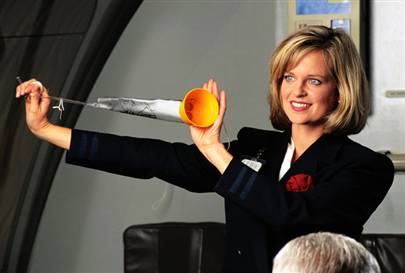
She reminded us of the safety speech that flight attendants used to give before takeoff (now it is usually on a video). They would say that in case of a sudden loss of cabin pressure, oxygen masks would drop from the ceiling. After instructing us how to put it on and start the flow of oxygen, they would tell us that passengers traveling with young children should put their own mask on first and then help their children. Harlene taught us what should have been (and should still be) obvious: If you put the child’s mask on first, we might not be able to breathe well enough to take care of ourselves. And what if our children need us after getting the mask on?

We need to get the parents to put on their Jewish learning and living masks. Otherwise we will have a generation of adults with the Jewish identity and connection of at best a thirteen year old. We need to get them to understand that they need to belong to a synagogue and send their children to religious school (or day school) because that is something that is vitally important to them. And we can only do that through personal relationships. We need to be artists.

I have some ideas. More on this soon.

Cross-posted to Welcome to the Next Level


[1]Seth’s blog is at http://sethgodin.typepad.com/seths_blog/ and his books can be found at http://www.sethgodin.com/sg/books.asp. I have taught about The Idea Virus and the Purple Cow, and recommend them!

[2] Thanks to http://www.airodyssey.net/tvc/tvc-united.html" for the description of the ad and the link to the Leo Burnett Ad Agency site for the clip.

Sunday, February 21, 2010

Tovim Ha-Shnayim...Strength in Numbers

Collaboration: A recursive process where two or more people or organizations work together in an intersection of common goals.
Merger: When two organizations join together into one, with one organization surviving and the other disappearing. The assets and liabilities of the disappearing entity are absorbed into the surviving entity.


We are at a time in American Jewish history that’s transforming the Jewish Community as we have known it to be. Agencies are responding to the recession by closing down, merging, collaborating in new ways, and re-identifying themselves. And so we hear about two agencies merging and we mourn for the loss of one of them. Or congregations create a combined high school and we are saddened at the implication that their numbers were too low on their own so they had to collaborate as a matter of survival. We assume that when congregations merge, they are in a position of weakness and they had no other choice.


But mergers and collaborations are potentials for streamlined efforts, for exciting new initiatives and for stronger communities. When a congregation can reflect on its strengths and weakness, and

work with others in the community

to support and build on the others strengths and weaknesses, the end users, the congregants (and the community) are the beneficiaries.


We know that this is a difficult time for synagogues; population studies are showing us that our communities are older, intermarried and not affiliating, and shrinking in size. Research is showing us that Movement demographics are shifting; buildings are aging; both Day Schools and Congregational schools are struggling to fill their classrooms (with students and qualified, quality teachers.) And in many communities, synagogue leaders are territorial – if it doesn’t happen within our walls, it’s not good for our congregation.


So what is a congregation to do?

How does the leadership consider options for moving beyond the proverbial four walls and network and share with other congregations in their area in order to strengthen their home congregation?


This is part of my work at the Auerbach Central Agency for Jewish Education/Jewish Outreach Partnership www.acaje-jop.org (a recently combined agency still working on a new name). Later this week we will be meeting with synagogue leaders to talk about collaboration and how building relationships and networks can provide opportunities. It is our belief that there are numerous ways to collaborate without losing institutional identity while providing services to the community, often at a higher level of quality.


The difficult economy has a silver lining for the Jewish Community if we can take a step back, reflect, and see what we have to offer each other. Kohelet, Ecclesiestes said it quite well – Tovim ha-shnayim min ha-echad: Two are better than one.

ShareThis